
History
In the 1870s around 200 people lived in Arnside.
Children had to walk over the fields to Beetham for school in all weathers.
Local residents, encouraged by the Wesleyans under the leadership of Robert Gibson, banded together to set up a school under the British and Foreign Schools Society on Briery Bank, which is now called 'The Cottage'.
This is how it looks today:
(...and this is how AI imagines it might have looked at the time it was the British School:...)
In the evenings, the school was used for meetings and lectures; the beginnings of Adult Education in the village.
The British School on Briery Bank operated for 13 years but the trustees had ongoing problems recruiting and retaining school masters and mistresses. These were compounded by the fact that Arnside was part of Beetham Parish rather than a separate parish of its own. As a result, the Government were unable to form (and fund) a School District in the village following the 1870 Act. An HMI inspection report in 1882 described the pupil's standard of reading as 'Good', and their composition as 'Fair' but said 'The rest of their Elementary work is miserably poor'. Following this, the Government Grant was cut by a quarter. More staff resignations followed and in June 1886, it was announced that the school was to be closed on the 30th July 1886.
A Sunday School had been built on Silverdale Road in 1880 (which is now Our Lady of Lourdes Catholic Church) and this now became the Church National School (which remained there until 1971).
In 1886 the National School formally took over the responsibility of educating Arnside children but the EI, in the building that had been the British |School, continued to host lectures, adult education, a reading room, a library and social events.
The EI Trustees exchanged the Briery Bank building for the Pier Lane Reading Room and established a new Arnside Educational Institute, which opened in 1889. The Pier Lane Reading Room was used for classes and lectures and had a Library, Reading Room and News Room. As the village grew, the Educational Institute needed bigger premises and bought the nearby 'Bush's Assembly Hall' (originally Bush's Coach House) on Church Hill which is where it has been sited ever since. This new Educational Institute was opened in 1926 and extended its activities to include a Ladies Section, Badminton Club and a Dramatic Society.
The new premises for the Educational Institute had been built as the stables and coach house for Bush's Albion Hotel and some of the rooms in the current EI show signs of their previous role.
The metal columns in the Kent Room, for example, were originally the framework for the stalls where traveller's horses could be fed and watered while they enjoyed the hospitality of the Albion Hotel.
Activities at the EI included Keep-fit, English Literature, Motor Engineering, Billiards, Upholstery, Badminton, and Gymnastics. During the Second World War, the EI organised the formation of savings groups to purchase National Savings Certificates for the War Effort. The main hall was used to provide education for evacuees and members of the National Defence Corps stationed in Arnside to guard the viaduct were given honorary membership. Waste paper and scrap iron were collected and the Jam Committee produced 698 lbs of jam in one year!
After the war, the EI carried on as before, hosting Parish Council and Rural District Council meetings as well as flower shows and concerts.
In 1983 the roof was found to be in disrepair and a group was formed by Margaret Matheson, to open a 'New Curiosity Shop' selling second hand goods, originally from Margaret's home and later from the EI. Over the following 17 years, Margaret and her team raised over £60,000 for the maintenance and refurbishment of the building. There is a room in the EI named after Margaret in honour of her achievement.
In 2000 the EI was fortunate to be the beneficiary of a substantial bequest from Joyce Nicolson, the owner of the Inglemere Hotel in Arnside, which had been demolished in 1975 and developed as a housing estate. The proceeds of the bequest have secured the long term future of the Arnside Educational Institute and provide grants which are available to local organisations as well as students in the second and third year of college and University courses.
The Institute has a long and illustrious history of providing and promoting its objective:
'The education of persons residing in the Parish of Arnside and the surrounding areas'
...thanks to the hard work of the community of Arnside, groups and societies who use the Institute and the unstinting work of the committee, caretaker and Centre Manager.


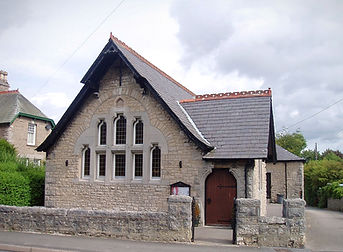

Our Lady of Lourdes Catholic Church.
Pier Lane, Arnside


Metal columns, originally part of the horse stalls,
in the Kent Room
Bush's Albion Hotel c. 1910

The Elephant in the foyer of the AEI was part of a bequest from Joyce Nicolson.
Originally, it stood by the entrance to the Inglemere Hotel in Arnside.

Further information about the history of the Arnside Educational Institute can be found in the publication 'Arnside Educational Institute 150 years 1873 - 2023' by Norma Platts, copies of which can be purchased from the Arnside Archive or the AEI office during office hours on Tuesday or Thursday mornings.
I am grateful to have been able to use this book as a source of material for the above.